AI in Mathematics: Revolutionizing Learning and Real-World Problem Solving
Artificial intelligence is rapidly transforming mathematics education, making mathematical concepts more accessible and applicable to everyday life. Through AI-powered tools, both students and teachers are finding innovative ways to connect math to real-world scenarios, especially in areas involving personal finance and business. This article explains how AI is changing the way we learn and use mathematics, with a focus on practical benefits and money-related skills.
Artificial intelligence (AI) is ushering in a new era in mathematics education. Once limited to textbooks and traditional classroom teaching, math is now being brought to life through technology — and AI is at the forefront of this change. In the United States, where approaches to mathematics education can vary widely between states and even within local districts, AI tools are helping bridge gaps and create more personalized learning experiences for students.
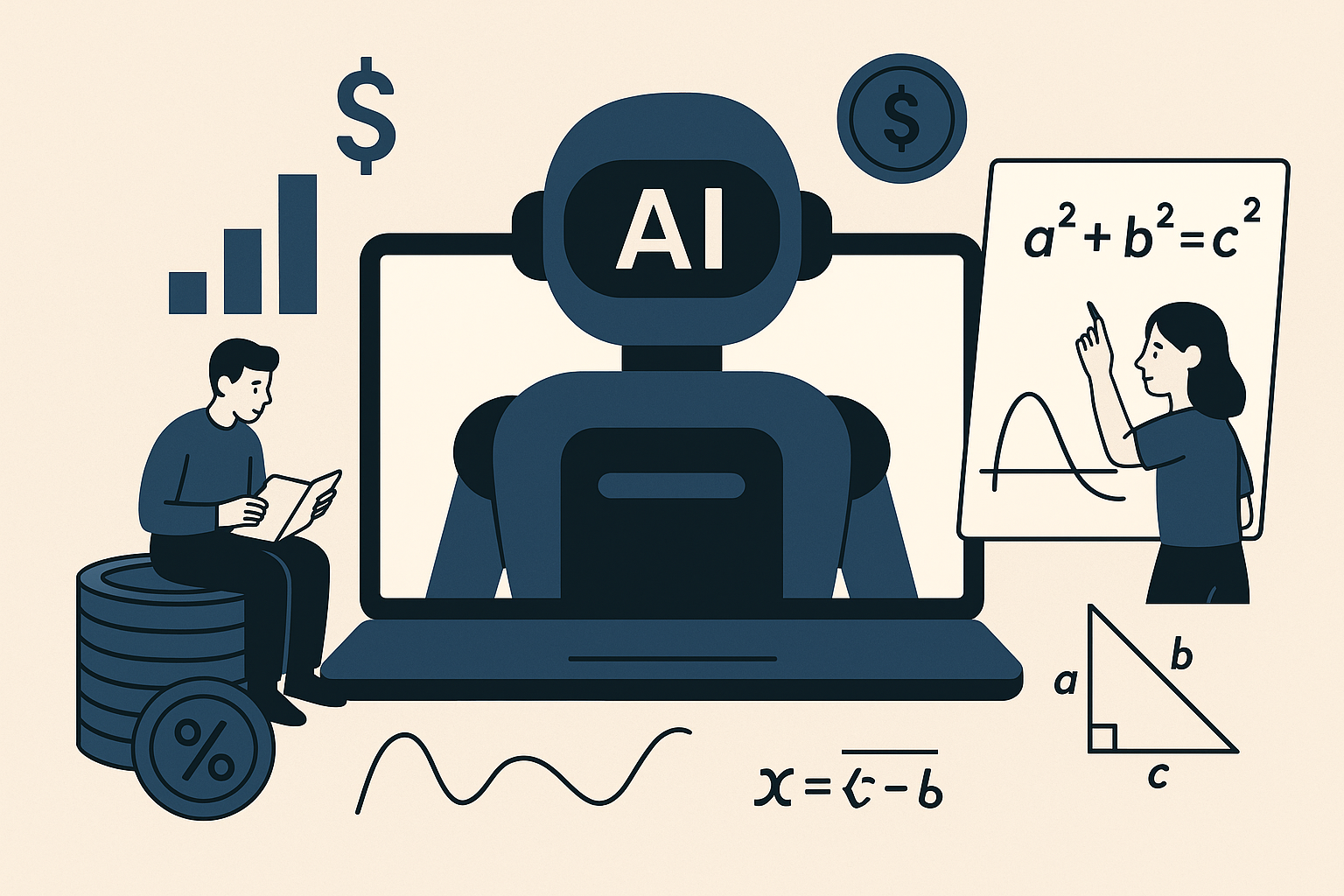
At its core, AI leverages advanced algorithms and vast amounts of data to mimic aspects of human intelligence. When applied to math education, AI can deliver instant feedback, adapt to each learner's pace, and offer targeted practice in areas where students struggle. For example, platforms like Khan Academy and Squirrel AI use AI to recommend practice problems, explain complex topics, and provide step-by-step hints tailored to what each student needs. This means students aren’t left behind due to pace or teaching style differences. Instead, they get support that adjusts, just as a dedicated tutor might.
One of the most practical aspects of mathematics — and where many learners see its real-world value — is in finance and money management. AI's impact here is particularly powerful. Personalized learning tools can present math through scenarios like budgeting, shopping, investing, or calculating interest rates on loans. By connecting abstract concepts to decisions people make every day, AI makes subjects like algebra and statistics far more relevant. Imagine a high school student learning to calculate compound interest not just as a formula, but through an AI-powered simulator that lets them see how saving or borrowing money grows or shrinks over time — a life skill with direct monetary implications.
Teachers are also finding AI to be a strong partner in the classroom. AI can help educators identify class-wide trends and individual stumbling blocks. If a group of students is struggling with linear equations, for example, the software can alert the teacher and suggest targeted lessons or activities. This helps instructors focus their efforts where they're needed most, making math instruction more efficient and meaningful. This technology is being adopted not only in traditional classrooms, but in after-school math clubs and online education platforms, which can reach a broader, more diverse group of learners.
AI isn’t just a passive tool for consuming information. Newer AI-powered apps allow students to engage with real-world data — like housing prices, interest rate trends, or grocery costs — and apply mathematical models to analyze and solve practical problems. For example, some programs give students virtual budgets and challenge them to maximize savings or minimize costs using mathematics. Through these interactive exercises, learners see the value of math in everyday decision-making, from setting up a bank account to comparing phone plans.
While AI brings many benefits, educators emphasize the continued importance of foundational skills and critical thinking. There's an ongoing conversation about balancing technology use with classic methods to ensure students build deep understanding rather than just relying on smart software. Leading mathematicians and AI researchers, such as those supported by mathematics-focused charities and research centers, are involved in shaping how AI is integrated into curricula.
In conclusion, AI is making mathematics more approachable, personalized, and practical. By linking mathematical concepts to real-world money scenarios and adapting to individual needs, AI is equipping learners with skills that are useful for both everyday problem-solving and future careers. As AI technology advances and becomes more widely available, its role in mathematical education and real-life financial literacy will likely continue to grow.