Demystifying Algorithmic Trading: How Math Moves Money
Algorithmic trading combines technology, mathematics, and finance to shape today’s global markets. This article unpacks the basics, explains the practical math behind trading bots, and explores how algorithms have changed our relationship with money and investing.
With just a few lines of code, millions of dollars can change hands in financial markets—a far cry from the days when trading floors buzzed with people waving paper orders. This evolution is possible because of algorithmic trading, a technology that has transformed not only finance but also the way we think about money, risk, and market dynamics. In this article, we break down how algorithmic trading works, the math at its core, and its real-world impact.
Algorithmic trading, sometimes called 'algo trading,' is the use of computer algorithms to automate buying and selling financial securities like stocks, currencies, or commodities. Instead of a human watching the market and placing trades, a program follows pre-set instructions—called trading strategies—to make decisions at speeds and frequencies far beyond human capabilities. For example, one popular strategy is 'momentum trading,' where algorithms rapidly buy assets whose prices are rising and sell those whose prices are falling, trying to profit from small, frequent price changes.
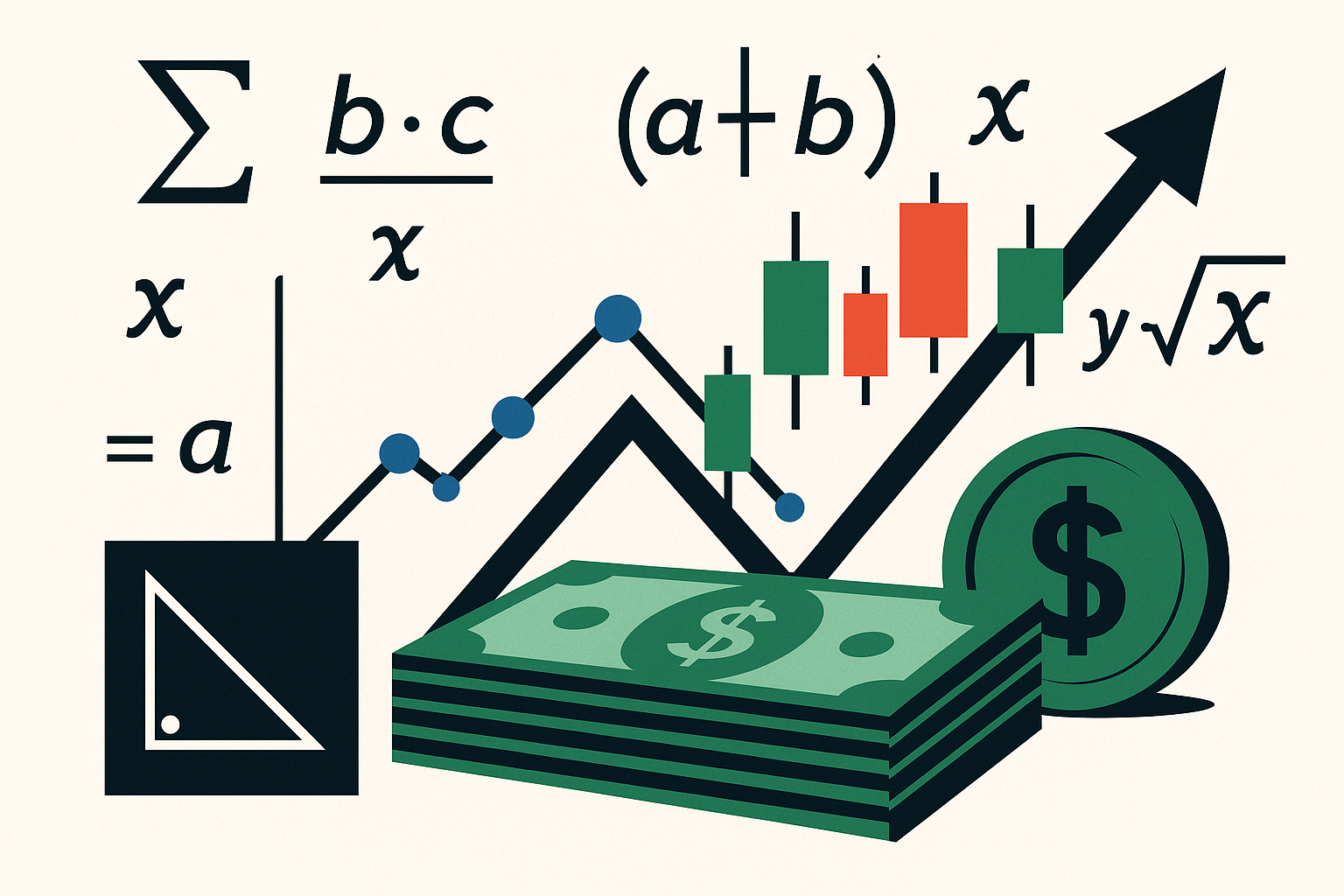
So, how do algorithms decide when to trade? Mathematics is the heart of these decisions. Consider a simple moving average—a common mathematical technique where the algorithm tracks the average price of a stock over, say, the last 50 trades. If the current price jumps above this average, the algorithm might interpret it as a signal to buy. Layered on top of these signals are more complex computations: algorithms can process hundreds of data points in real-time, using principles from probability, statistics, and even game theory to weigh potential gains against risks.
Algorithmic trading connects directly to real-world money in powerful ways. High-frequency trading (HFT), a subset of algorithmic trading, executes thousands or even millions of trades in a single day. Each micro-trade might earn just a fraction of a cent, but in aggregate, these can add up to significant profits—or losses. As with any kind of investment, algorithmic trading carries risks. For instance, Haim Bodek, an expert in volatility trading, once saw his successful algorithms start losing money when market conditions changed unexpectedly, illustrating that no mathematical model is perfect.
Major financial firms and even independent traders use algorithmic trading to navigate big, complex markets such as the New York Stock Exchange or the foreign exchange market. Programmer-traders like Brett Harrison and mathematicians like Jim Simons have built entire careers—and sometimes fortunes—on developing proprietary algorithms. Their work signals a blending of programming, mathematical skill, and financial know-how, proving that practical mathematics can lead directly to real-money outcomes in the global economy.
Algorithmic trading also raises important questions about fairness and regulation. Markets dominated by ultra-fast trading bots can react in milliseconds to news or rumors, sometimes leading to sudden price swings or unintended spikes. Governments and regulators increasingly rely on 'algorithmic governance' as well, using similar computational tools to oversee and regulate markets—a dynamic blend of automation and oversight sometimes called 'government by algorithm.'
For anyone interested in learning more, getting started with algorithmic trading involves both technical and financial education. Beginners often experiment with free tools to write simple trading scripts, back-test them against historical data, and slowly appreciate the balance between risk, reward, and the rigorous logic of math. With the right skills and knowledge, algorithmic trading is more than just a buzzword—it’s a window into the future of finance, where math and money move together at the speed of light.