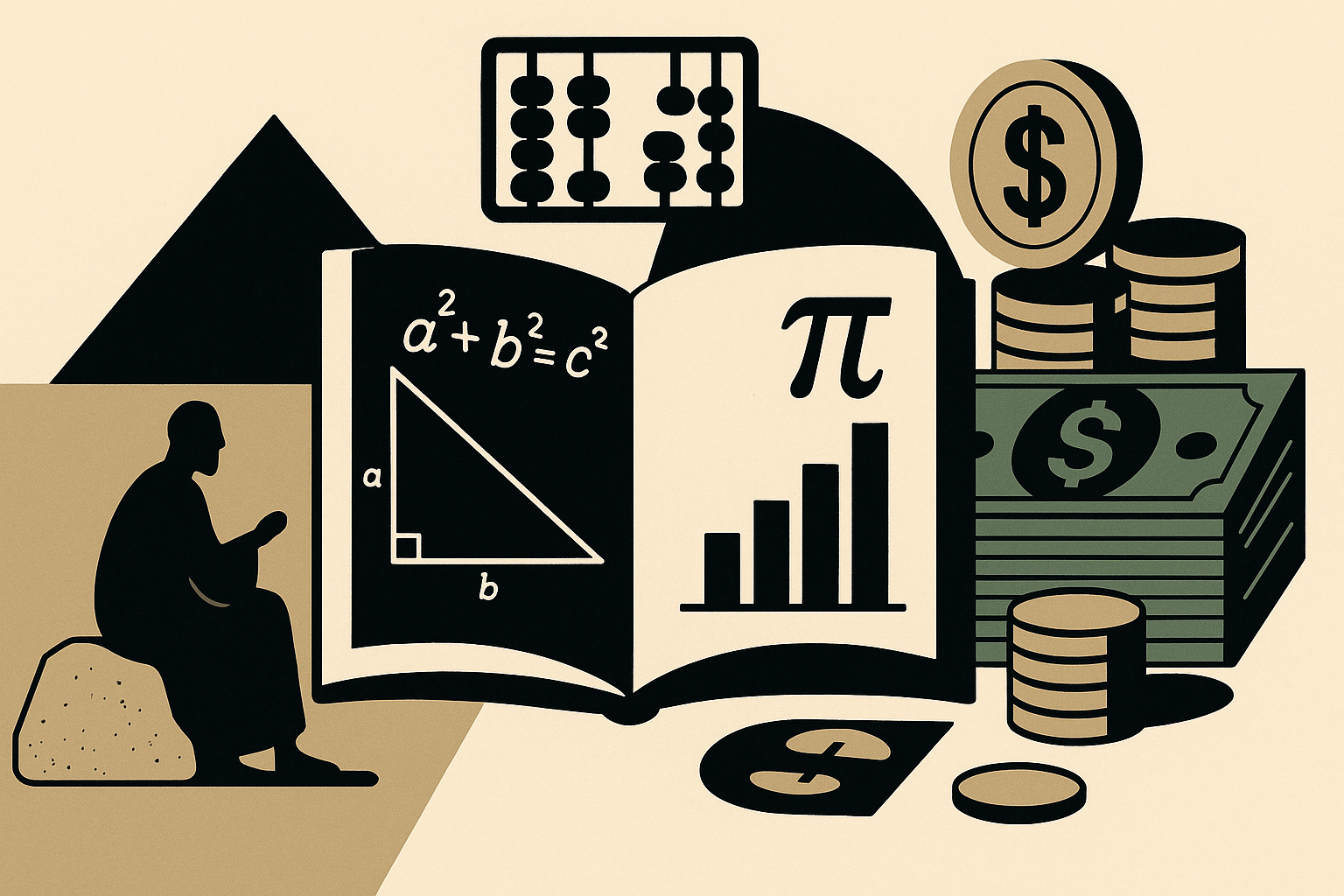
The History of Mathematics: From Ancient Counting to Modern Money
Mathematics has shaped the way we understand the world, manage resources, and handle money throughout history. Explore how practical needs—from the marketplace to modern banking—drove math’s development, and see its vital role in everyday life.
Mathematics is often seen as a set of challenging rules and formulas taught in schools. But its story is much more engaging and practical. The history of mathematics is closely tied to real-world needs like counting, measuring, and handling money. These everyday activities drove people to create the very math skills we use today, proving that mathematics has always been about solving real problems.
Our journey begins in ancient times. Early civilizations in Mesopotamia and Egypt developed arithmetic—basic skills like addition and subtraction—to keep track of crops, trade goods, and taxes. Clay tablets from thousands of years ago show records of transactions, demonstrating that math was vital for managing resources and running economies. The need to divide land, measure harvests, and settle debts led to early multiplication and division, laying the groundwork for more advanced calculations.
As societies grew, so did their mathematical needs. The Greeks introduced geometry, largely to measure land and construct buildings with precision. Their discoveries—like the concepts of the circle and triangle—became crucial not just for architects, but for everyone involved in building and design. In India and the Middle East, scholars developed the concept of zero and new ways of calculating with large numbers. This made it easier to track markets and profits, and these advances spread along trade routes into Europe.
Money has always been a powerful motivator for mathematical innovation. With the invention of coins and currency, merchants needed methods to calculate change, interest, and exchange rates. During the Middle Ages, as trade expanded, European mathematicians improved arithmetic to meet the needs of bankers and traders. They worked out ways to calculate percentages—like figuring out the cost of a loan or the profit from a sale—which remain essential skills in managing personal and business finances today.
The practical uses of mathematics continued to grow. During the Renaissance, the spread of double-entry bookkeeping transformed accounting, making business transactions more reliable. Calculating profit and loss, balancing budgets, and even predicting market trends all depended on solid mathematical methods. Today, everything from budgeting for groceries to using credit cards or online banking is built on centuries of mathematical progress.
Mathematics education now includes not only arithmetic, but also geometry, statistics, and algebra, reflecting the many ways math is needed in modern life. It prepares students to understand interest rates, compare prices, and navigate the digital economy. For instance, understanding percentages and decimals is key when shopping during a sale or calculating a tip at a restaurant.
From ancient farmers and merchants to today’s consumers and professionals, the history of mathematics is deeply connected to the way we manage time, money, and resources. By tracing mathematics’ practical origins, we can better appreciate its relevance—and its power to help us make smart decisions in our daily lives.