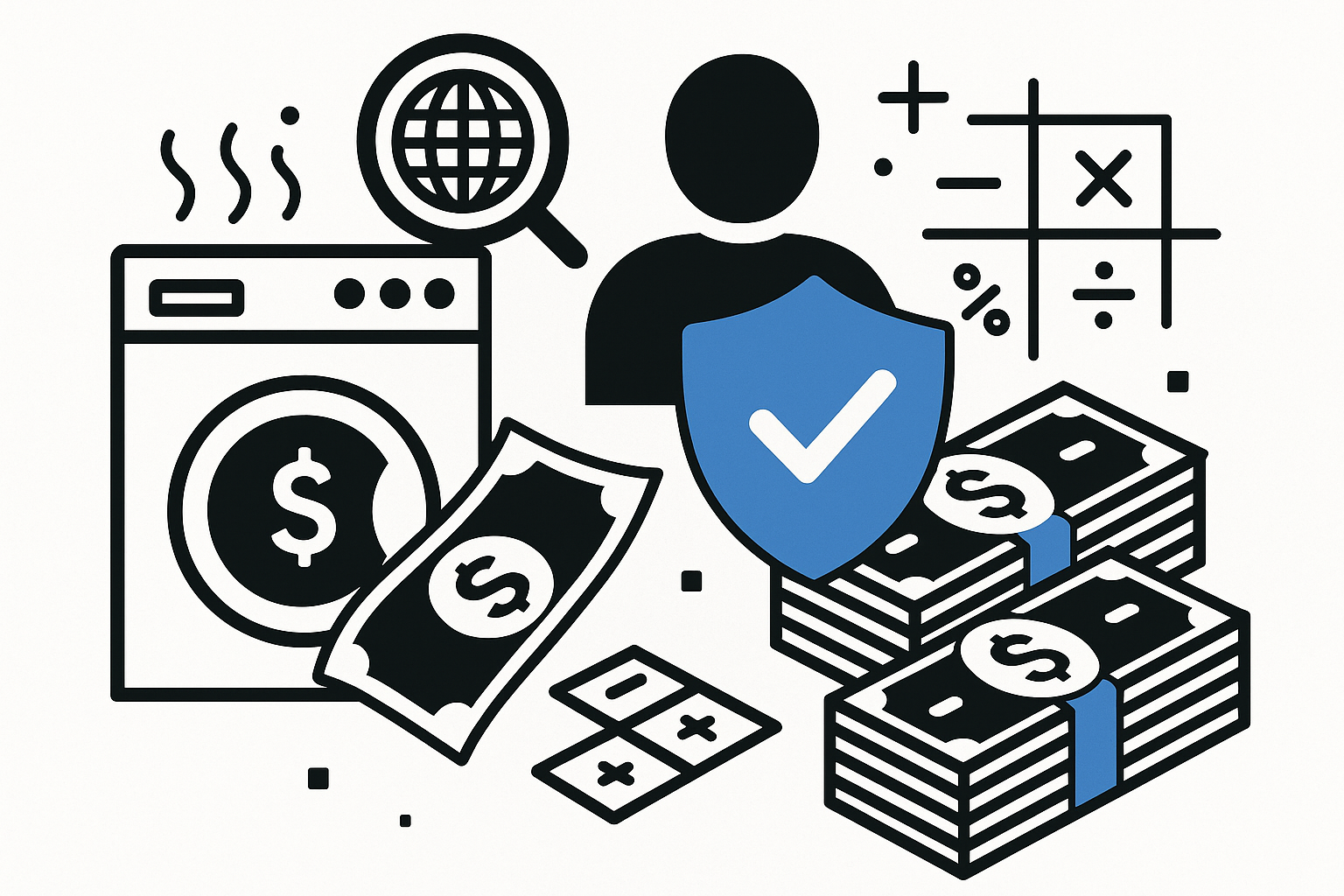
Understanding Anti-Money Laundering: Keeping Crime Out of the Financial System
Anti-money laundering (AML) is a crucial part of the fight against financial crime, using rules, mathematical analysis, and real-world detective work to stop illegal money from blending into the legitimate economy. This article explains what AML is, why it matters, and how critical everyday skills—especially in money and mathematics—can play a role.
Money laundering is the process criminals use to disguise the origins of illegally obtained money, making it appear as if it comes from legitimate sources. Over decades, authorities and financial institutions have developed anti-money laundering (AML) strategies to prevent the financial system from being misused by criminals. Understanding AML involves not just legal concepts, but practical skills in observing transaction patterns, handling money, and even basic mathematics.
Why is AML so important? If criminals can easily make dirty money look clean, they are free to grow their enterprises—from drug trafficking to terrorism. Stopping money laundering means cutting off this lifeblood, making criminal activity less profitable and helping society as a whole. Thus, banks, government agencies, and even businesses in other sectors constantly monitor for suspicious activity.
One core element of AML is detecting unusual financial behavior. For example, banks are mandated to report transactions over certain limits (often around $10,000 in many countries), but money launderers might try to avoid this by splitting large amounts into smaller deposits—a method known as 'structuring'. Here, basic math skills are essential. If a series of deposits—such as $4,995, $5,200, and $3,100—are all made within a few days by the same individual, AML professionals need to add them up, notice the pattern, and consider the total in relation to reporting thresholds.
Real world money flows are the heart of AML investigation. Imagine you work in a bank and regularly see many small deposits to a new business account. You might ask: Do these transactions make sense for the business type? Are the amounts, sources, and frequency aligned with what a bakery, auto shop, or consulting firm would typically handle? Here, practical knowledge about how businesses operate helps spot red flags.
Technology has amplified both the risks and the tools. Today, advanced AML systems use mathematical algorithms and big data to automatically flag transactions with suspicious patterns. An example: software might recognize that a sudden spike in volume—a thousand small transfers, for instance—deviates from someone's normal banking habits.
Learning about AML isn’t just for banking professionals. Free online courses and practical guides (such as those offered on Alison or Course Cloud) introduce the concepts of risk, identification, and prevention. These resources teach you how to analyze evidence, follow money trails, and apply simple arithmetic to connect the dots in real-world cases.
In classrooms and training centers, mathematics is often taught with a focus on abstract problems. However, anti-money laundering shows how math becomes a real-world detective tool: adding up deposits, calculating averages, or noticing trends over time can all help uncover wrongdoing. The combination of observation, logic, and number skills is key to protecting the financial system.
In summary, anti-money laundering is an essential defense against crime. By blending legal frameworks, real money awareness, and everyday math, AML helps ensure that the financial system serves everyone fairly—and deters those who would abuse it. Whether you’re entering a finance career or just want to be a smart consumer, understanding the basics of AML gives you a practical edge in today’s interconnected world.