Understanding Compound Interest Calculators: Mathematics in Action
Compound interest calculators are powerful tools that help individuals and businesses make informed financial decisions by demonstrating how investments grow over time. By blending mathematical concepts with real-world applications, they transform abstract numbers into meaningful insights about the time value of money.
Mathematics is not just about numbers on a page; it’s about applying concepts to real-life scenarios. Among these applications, few are as practical or eye-opening as learning about compound interest. A compound interest calculator is a tool designed to illustrate how money can grow when interest accumulates not just on the initial principal, but also on the previously earned interest. This seemingly simple idea has profound implications for savings, investments, loans, and our overall understanding of the value of money over time.
To grasp compound interest, it’s essential to understand the concept of the 'time value of money.' This principle, discussed in financial and economic literature for centuries, suggests that a sum of money is worth more now than the same sum in the future due to its potential earning capacity. Compound interest leverages this idea by allowing money to earn interest on both the amount initially invested and the interest that has already been added to it. In practice, this leads to exponential growth, an idea mathematically represented using constant 'e'—an important value in many fields (as noted in the study of mathematical constants).
Let’s look at a practical example: Sally invests $1,000 at an annual interest rate of 5%, compounded yearly. In the first year, she earns $50 in interest, bringing her total to $1,050. In the second year, she earns interest not just on the initial $1,000, but on the new total of $1,050, resulting in $52.50 of interest. Over several years, this effect stacks up, causing her savings to grow faster and faster—a result clearly demonstrated by compound interest calculators.
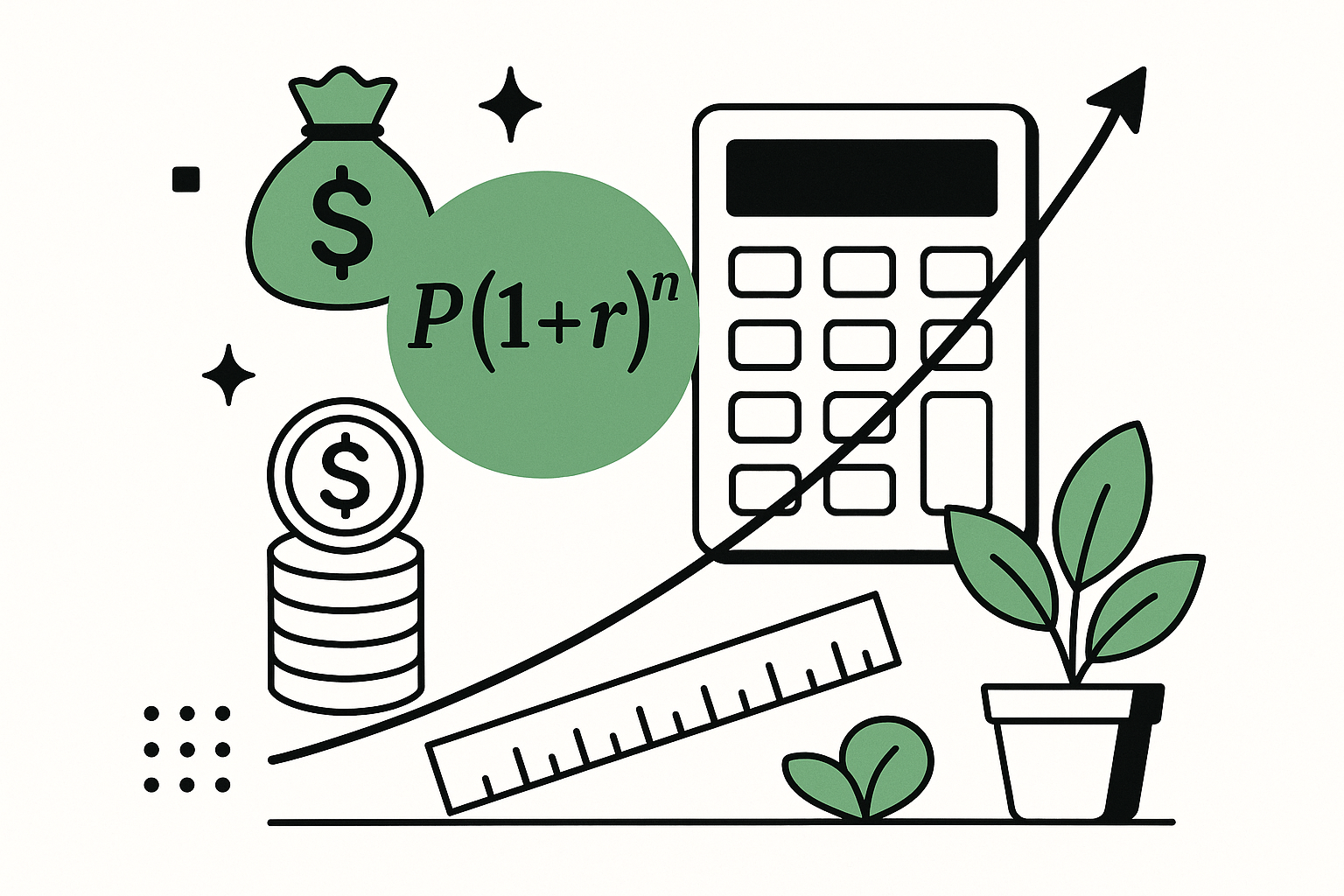
Compound interest calculators make this math accessible. By inputting basic information—such as starting amount, interest rate, compounding frequency (yearly, monthly, daily), and the number of years—you can instantly see how your investment grows. These calculators automate the formula: A = P(1 + r/n)^(nt), where 'A' is the amount after time 't', 'P' is the principal (starting amount), 'r' is the annual interest rate (expressed as a decimal), and 'n' is the number of times the interest is compounded per year. Performing this calculation by hand can be a challenge, especially with frequent compounding and long periods, but calculators streamline the process.
Historically, before the digital era, people used mechanical aids like slide rules to perform compound interest calculations—impressive feats of both craftsmanship and mathematical understanding. Today, digital calculators and online tools have made it easy for anyone to experiment with different scenarios and plan for the future. This democratization of financial mathematics empowers consumers, students, and professionals alike.
The connection to real-world money management cannot be overstated. Whether you’re planning for retirement, saving for a big purchase, or considering a loan, understanding how compound interest works can help you make better decisions. Many financial products, like savings accounts, mortgages, and investments, depend on compound interest. By using a calculator, you can see how, for example, a small increase in interest rate or a slightly longer investment period greatly impacts your end result.
However, it's important to remember that compound interest isn’t just about gains. Debts like credit cards and loans often use compound interest too, leading to rapidly increasing balances if not managed properly. This is why tools that make the math clear are so valuable: they help prevent costly mistakes as well as illuminate opportunities.
In summary, a compound interest calculator is not only a mathematical device but also an educational bridge between numbers and daily financial life. Its utility lies in transforming abstract principles into something tangible and actionable, reinforcing the essential lesson that in both mathematics and money, time matters.