Understanding Compound Interest Calculators: The Math Behind Growing Money
A compound interest calculator is a practical tool that brings mathematics to life, helping people visualize how their savings can grow over time thanks to the power of compound interest. This article explores how these calculators work, their mathematical foundations, and why understanding them is useful in real-world financial decisions.
Compound interest is one of the most important concepts in personal finance and mathematics. It describes the process in which money earns interest not only on the initial amount but also on the accumulated interest from previous periods. This creates a snowball effect where savings or investments grow much faster compared to simple interest, which is calculated only on the original sum. But how can we easily see how this works in action? That’s where a compound interest calculator steps in.
A compound interest calculator is a digital tool—available on many financial websites and apps—that helps you determine the future value of your savings or investments by factoring in the principal (the amount you start with), the interest rate, the number of compounding periods, and the total time your money will be invested. By inputting these numbers, you can quickly see how much your money could grow over several years. This turns an abstract math formula into a tangible projection, making it a practical bridge between mathematical theory and everyday life.
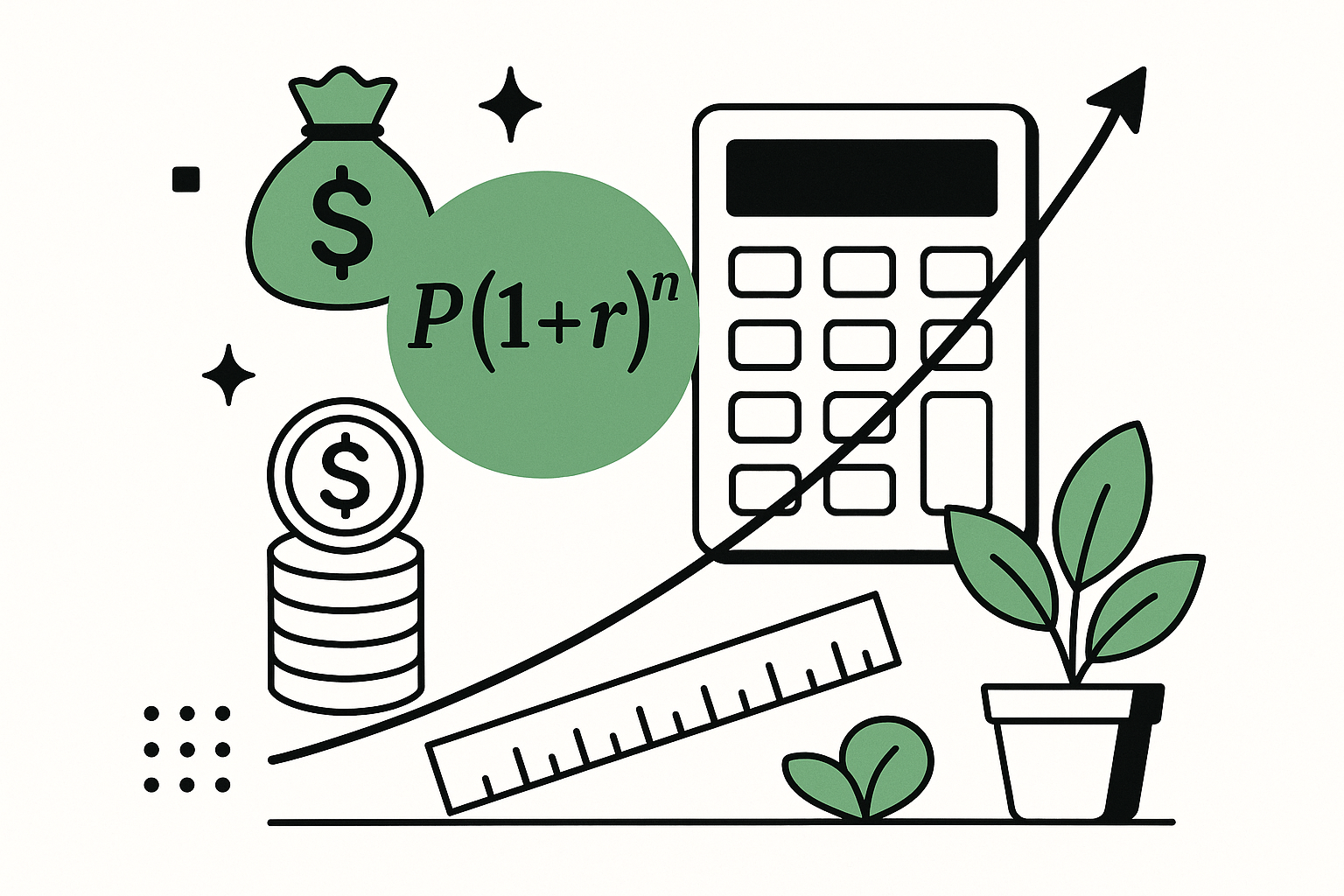
But what's the math behind a compound interest calculator? The basic formula is A = P(1 + r/n)^(nt), where A represents the amount of money accumulated after n years, including interest. P is the principal amount, r is the annual interest rate as a decimal, n is the number of times that interest is compounded per year, and t is the number of years the money is invested. This formula highlights how frequent compounding can lead to greater growth, and it introduces a key mathematical constant: e. In fact, as the number of compounding periods increases indefinitely, the formula involves e, which always arises in continuous growth processes and is approximately 2.718.
The application of compound interest stretches back centuries, forming the backbone of banking and investment practices since the Middle Ages. It’s not only a financial tool but also a topic that has inspired mathematical exploration and technological development—from early mathematicians like Gottfried Wilhelm Leibniz to the invention of mechanical calculators and the modern-day slide rule. Today’s compound interest calculators are the digital descendants of these innovations, bringing complex calculations to anyone’s fingertips.
Learning about compound interest has real-world relevance. For example, if a teenager saves $1,000 at an annual interest rate of 5% compounded monthly, a calculator will show how, after 10 years, the savings will grow more than if interest were compounded yearly or not compounded at all. This highlights the time value of money—a concept recognizing that a dollar today is worth more than a dollar tomorrow due to its earning potential. Compound interest demonstrates why saving early can have enormous benefits, making it a cornerstone of smart financial planning and investment strategy.
Inflation, another everyday concept, often works against compound growth by reducing the value of money over time. Some compound interest calculators allow you to factor in annual inflation rates, which is valuable for understanding the true growth of your savings in terms of purchasing power. This is an excellent real-life application where mathematics directly informs financial decisions and future planning.
For students and adults alike, using a compound interest calculator deepens understanding of percentages, exponential growth, and long-term planning. It’s a clear example of how mathematical operations—once calculated with pen, paper, or even slide rules—now empower individuals to take control of their financial futures. By experimenting with different inputs, users can see firsthand how small changes in rate, time, or frequency of compounding can have a big impact. This kind of practical, hands-on mathematical exploration not only boosts numeracy skills but also builds confidence in making everyday life decisions.
In summary, a compound interest calculator might seem like a simple online tool, but its foundations are deeply rooted in centuries of mathematical thinking, real-world finance, and practical technology. It’s an accessible way to witness the time value of money in action, encouraging smarter saving, investing, and an appreciation for how mathematics shapes our financial lives.