Understanding Algebra: The Building Blocks of Mathematical Problem-Solving
Algebra is more than just a subject in school — it’s a powerful tool for solving real-life problems, especially those involving everyday decisions about money and resource management. This article explains the basics of algebra, its importance in education, and how its concepts directly connect to decisions people make every day.
Algebra is often introduced in middle school mathematics, typically in courses called Pre-Algebra or Algebra I. At first glance, it may seem like a maze of letters and numbers, but at its core, algebra is a way of finding unknown values and expressing relationships between quantities. Its development marks an important step in mathematics education, bridging concrete arithmetic with more abstract reasoning.
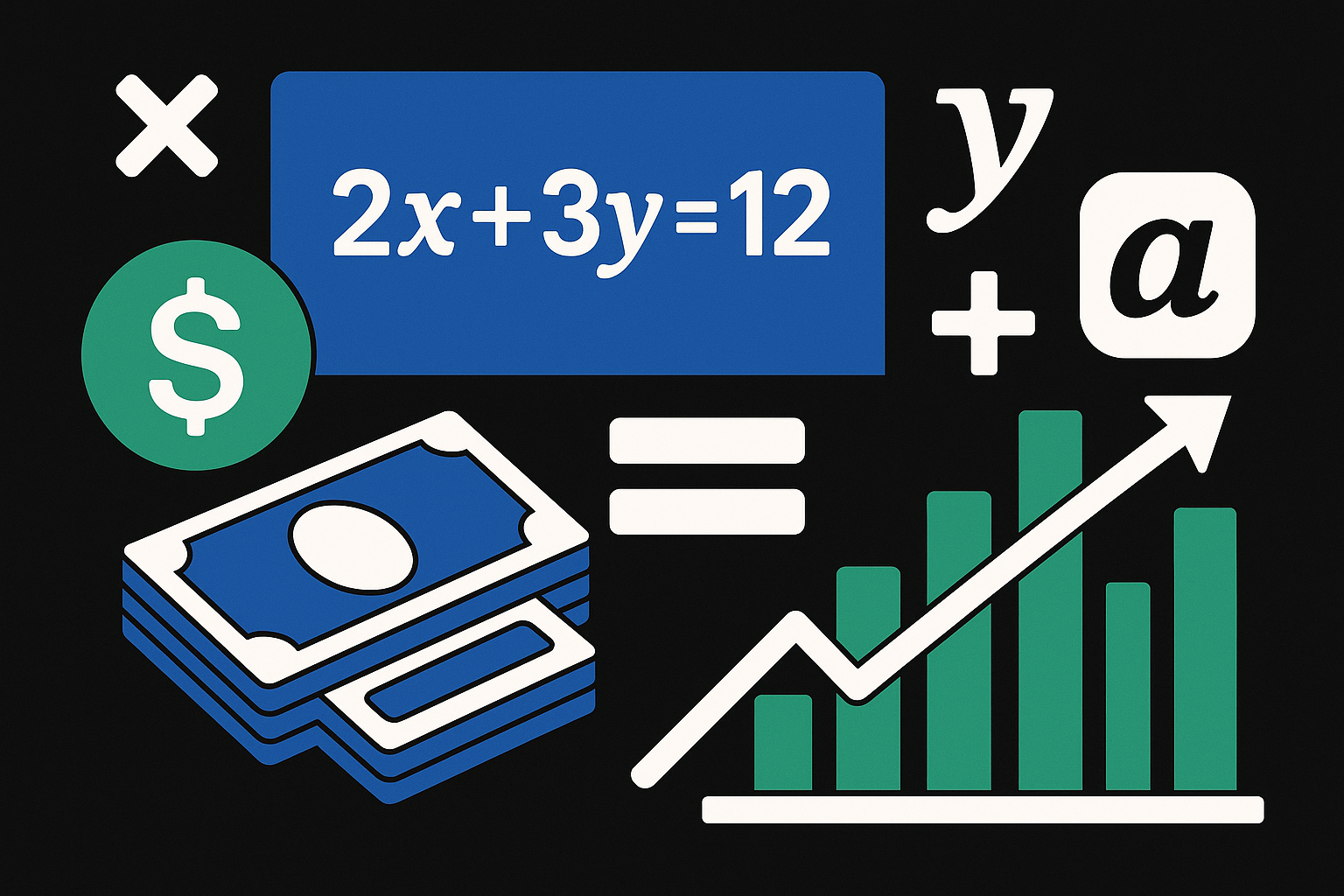
In its simplest form, algebra enables us to use symbols (often letters like x or y) to represent unknown numbers or changing values. For example, if we know that the total cost of buying 3 pens is $6, we can write the equation 3p = 6, where p stands for the price of each pen. Solving for p helps us find the price of a single pen quickly and reliably. This skill is fundamental, not only in school but in everyday life.
But why is algebra taught so widely in secondary schools? According to numerous mathematics curricula worldwide, including those in the United States, algebra is seen as a foundation for all higher-level mathematics and sciences. Understanding algebraic thinking helps students develop problem-solving skills and logical reasoning, which are essential regardless of whether one pursues a career in engineering, finance, medicine, or the arts.
One of the most immediate ways algebra connects to real-world scenarios is through personal finance. Consider budgeting: suppose you earn a certain amount per month (let’s call it I for income), have fixed expenses (F) like rent and utilities, and variable expenses (V) such as entertainment or dining out. Algebra allows you to model your monthly savings (S) as S = I - (F + V). By plugging in different numbers, you can forecast how various spending habits will impact your bottom line.
Algebra also plays a key role in understanding interest rates, loan payments, and investments. For instance, the formula for simple interest (I = Prt, where P is principal, r is rate, and t is time) allows people to see how their savings grow over time or what they will owe when repaying a loan. This makes algebra a vital skill for making informed decisions about everything from selecting bank accounts to taking out a mortgage.
Learning algebra helps students piece together larger mathematical ideas. Skills such as manipulating equations, identifying patterns, and using symbols build confidence and prepare learners for more specialized fields like statistics or computer science. In contemporary education, mastering algebra is often considered a “gateway” that opens future academic and career opportunities.
Even outside of mathematics, algebraic thinking—the ability to translate words into variables, set up equations, and logically solve for unknowns—proves valuable. Everyday decisions, like splitting a bill among friends or converting between currencies, all draw on the basic principles taught in early algebra classes.
Ultimately, algebra is not just about solving for x. It encourages a way of thinking that blends logic, precision, and creativity. By relating variables and finding solutions, individuals develop analytical skills with far-reaching impact. Whether you are balancing a checkbook, planning a trip, or analyzing business costs, the algebra learned in school forms an essential toolkit for managing life’s challenges.