Ancient Accounting: The Birth of Mathematics and Money Management
Long before the word 'accounting' existed, ancient civilizations developed systems to track goods, trade, and wealth. These early forms of accounting were not only essential for palace administrators and traders—they also laid the groundwork for the mathematics, recordkeeping, and money management we depend on today.
When we think of accounting today, we might picture spreadsheets, calculators, and ledgers filled with numbers and financial statements. But accounting is much older and more fundamental than its modern tools suggest: its origins trace back to some of humanity’s earliest civilizations. Understanding how ancient societies kept track of their resources is a practical lesson in both mathematics and the evolution of money—fields that remain deeply connected in our daily lives.
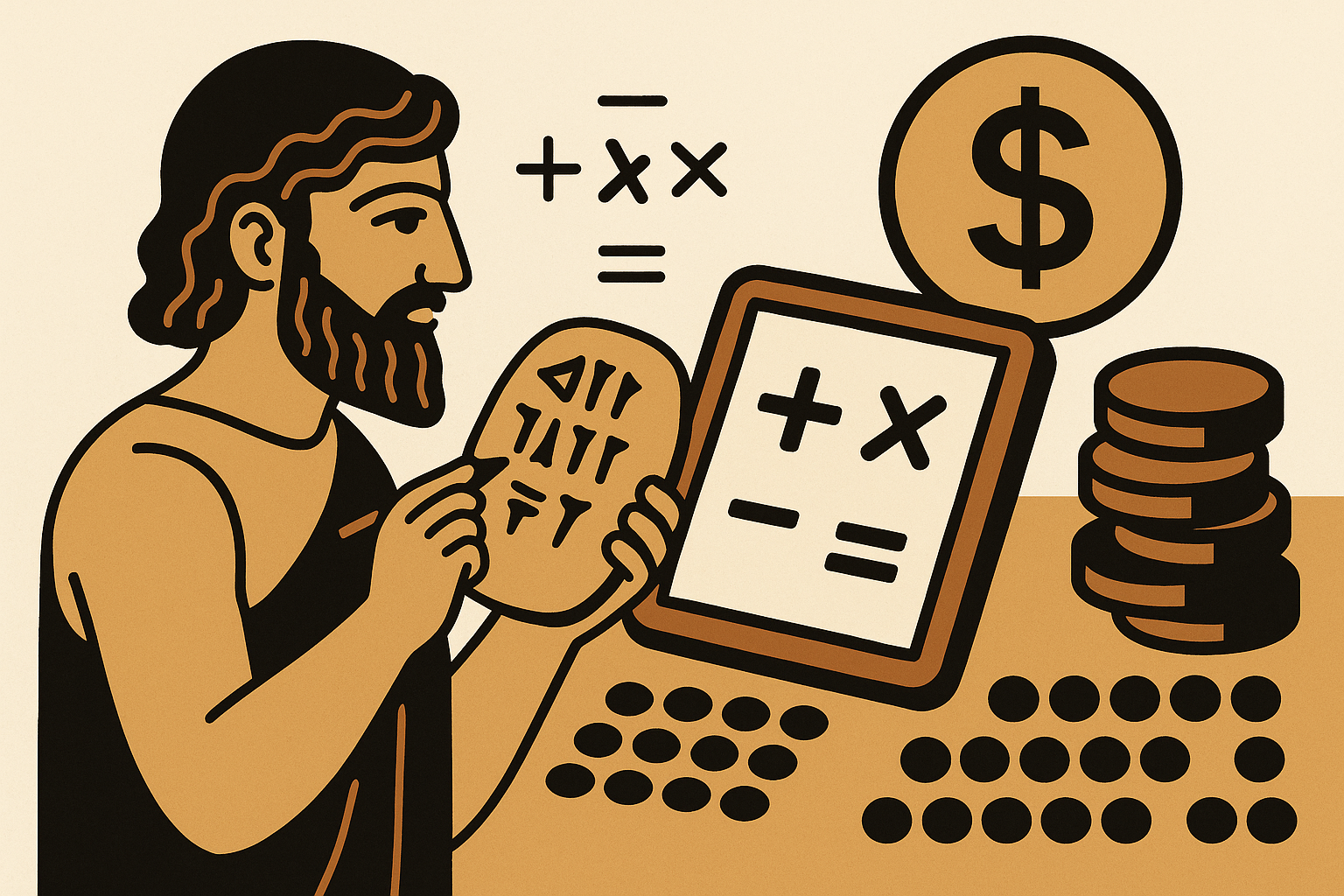
The history of accounting begins in ancient Mesopotamia, more than 7,000 years ago. There, temple officials and merchants needed ways to record transactions of grain, livestock, and other resources. Early Mesopotamian accountants used clay tokens to represent different commodities. Over time, these tokens were pressed into clay tablets, creating one of the world’s first written accounting methods. In effect, these tablets were the ancestors of both accounting records and written language itself.
Accounting was a practical solution to a real-world challenge: how do you manage the surplus from harvests or keep track of obligations and debts? For ancient societies, the answer was careful recordkeeping. This allowed them to plan for the future, collect taxes, distribute resources fairly, and organize complex economies. The skills required were mathematical at their core, involving simple addition, subtraction, and the concept of unit measurement—principles that still underpin financial accounting today.
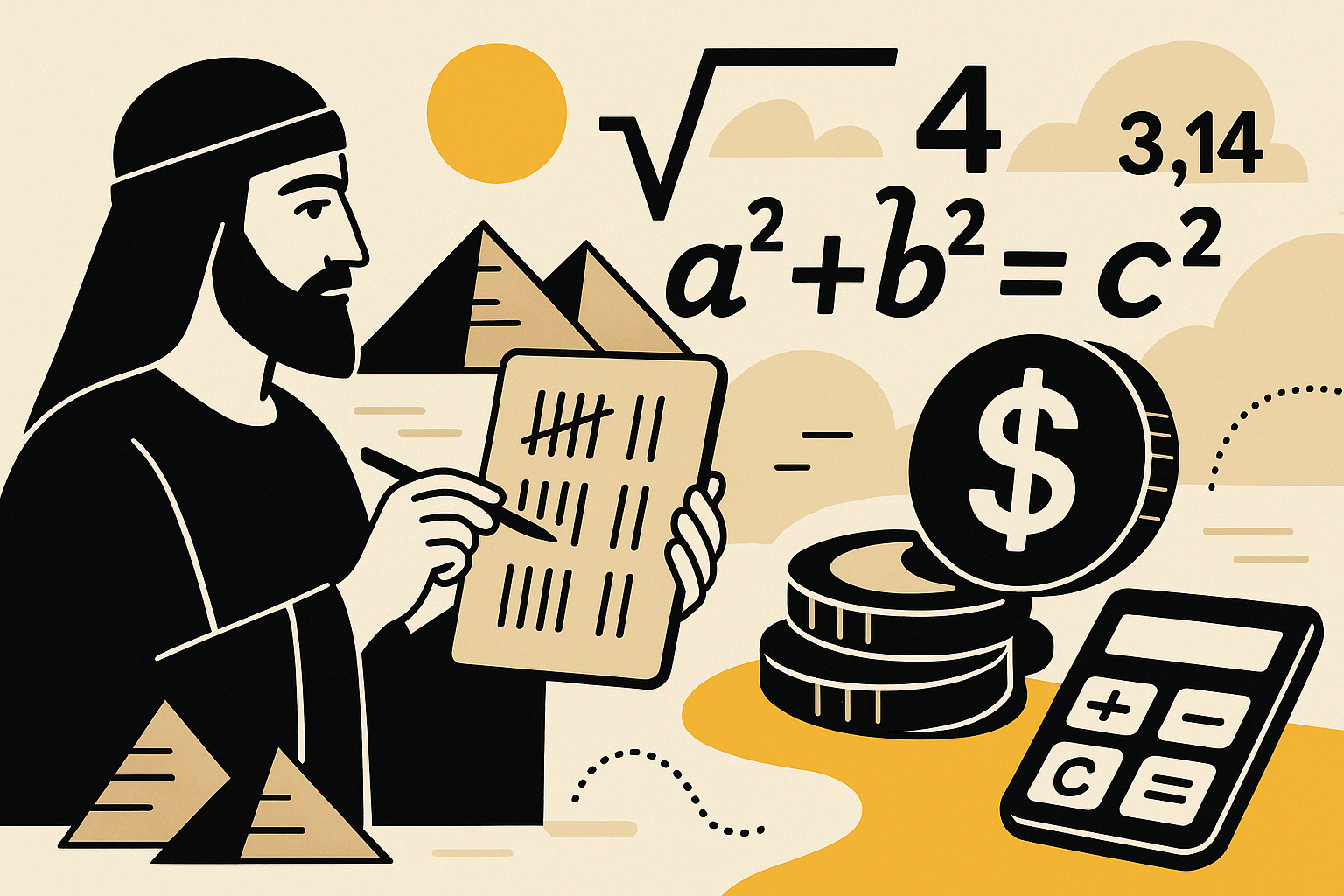
As civilizations grew, so did their recordkeeping needs. In ancient Egypt, for instance, scribes used papyrus scrolls to note quantities of goods and payments to workers. Ancient Greek and Roman accountants extended these practices; Roman administrators used detailed account books to track tax receipts and military expenditures. These early records helped governments maintain control and stability, relying on accurate numbers and clear units of account—concepts that would later be formalized in modern banking and financial management.
Accounting is closely tied to the idea of money as a 'unit of account.' In ancient societies, this could be anything from sheep to silver coins. Once a common medium of exchange emerged—such as metal currency—accounting made it easier to compare values, assess profits and losses, and conduct business over long distances. This practical development is central to how we use money and mathematics today; without the ability to record and compare values, trade and planning would be nearly impossible.
Ancient accounting practices were also part of early education. In Mesopotamia and Egypt, scribes underwent rigorous training in arithmetic, writing, and book-keeping. Their work laid the foundation for mathematics as an academic discipline, connecting numbers not just to abstract operations but to the realities of managing resources, debts, and payments. The legacy of this education endures: basic numeracy and money management are fundamental parts of modern schooling in mathematics and social studies.
As the field of accounting evolved, it developed specialized branches, such as cost accounting and tax accounting. However, the essential principles—measurement, recordkeeping, and assurance about finances—can all be traced to those early clay tablets and scrolls. For students and adults alike, learning about ancient accounting is a practical lesson in how societies solve common problems, use mathematics, and build trust through careful management of shared resources.
Understanding this history helps us see today’s accounting as more than a technical profession. It’s a universal language that blends mathematics, economics, and real-world organization—an ancient tool still at the center of money, education, and society.