From Barter to Bitcoin: The Fascinating History of Money
Money, a concept so central to our daily lives, has undergone an incredible transformation over thousands of years. Understanding its history reveals not only how societies have solved problems of trade and trust, but also important lessons in mathematics, economics, and even human psychology.
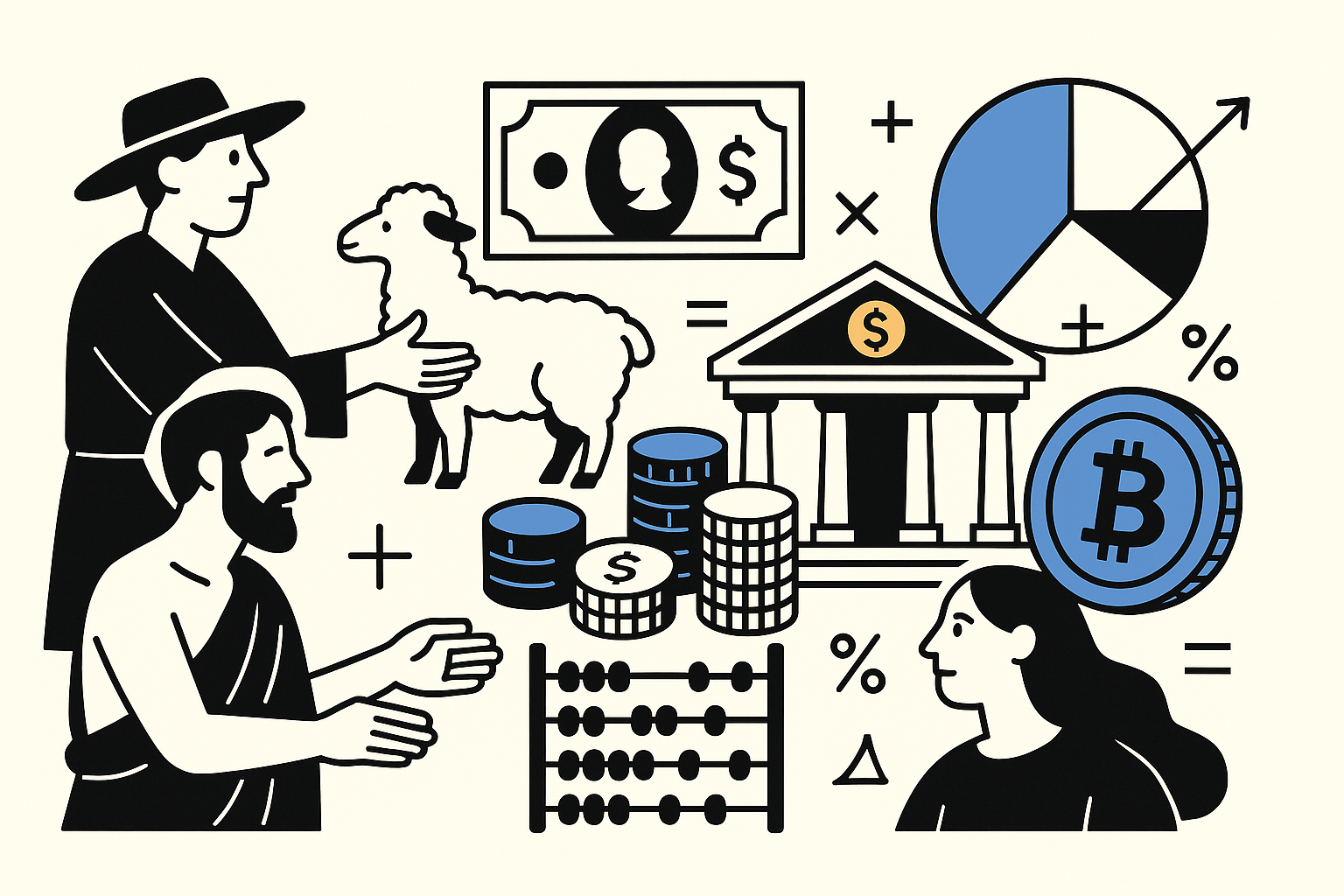
Money is everywhere in modern life, shaping everything from what groceries we buy to how we save for the future. Yet its beginnings were humble, rooted in the simple exchange of goods. Before money existed, people traded items directly through a system called barter. For example, a farmer might swap wheat for a shoemaker’s shoes. But bartering soon revealed its limits — what if the shoemaker didn’t need wheat? Societies needed a more flexible tool for trade.
This need for flexibility gave rise to the earliest forms of money. Early humans used items like shells, salt, grain, and cattle — objects considered valuable and widely accepted. These items functioned as "commodity money," which simply means they had both practical uses and could be traded for goods and services. Over time, societies began to look for even more practical and consistent forms of money.
One major leap occurred when precious metals, especially gold and silver, became money. These metals were valuable, easy to carry, and could be divided into smaller amounts for different values. Ancient kingdoms and empires began to stamp coins, making it easier to measure value and authenticity, and reducing disputes in trade. Coins made counting and mathematics an essential part of commerce, encouraging numerical literacy and basic calculations—skills we still use when handling money today.
As trade expanded and banking developed, carrying large amounts of heavy coins became impractical. This ushered in the age of paper money, first appearing in China over a thousand years ago. Paper notes were easier to transport and could represent larger values. This innovation relied on trust: people had to believe that the paper had value because it could be exchanged for something else, like precious metals, or because the government said so.
Today, most countries use what’s called "fiat money" — currency that has value not because it is backed by physical assets, but because governments decree it legal tender. This means its value is established by society’s trust and the health of a country’s economy. Fiat money, such as the dollar, euro, or yen, only works as long as people agree to use it for payments, savings, and loans. Modern money is mostly digital, existing as numbers in bank computers, which makes mathematical concepts like addition, subtraction, multiplication, and percentages more important than ever.
The history of money connects closely to real-world mathematics. Calculating change, comparing prices, and planning budgets are all mathematical activities. On a broader scale, economists use arithmetic and more complex math to track the money supply—the total amount of money in circulation—and analyze how changes in the economy impact everything from inflation to employment. Concepts such as the "time value of money" show us that a dollar today is often worth more than a dollar tomorrow since money can grow over time thanks to interest. This principle is vital for saving, investing, and understanding loans.
Even now, the story of money isn’t finished. New technologies, like cryptocurrencies and digital payments, are reshaping what money looks like and how we use it. Students and adults alike use math every day as they check account balances, calculate discounts, or save for a future goal. By understanding the history of money and its mathematical connections, we gain practical skills for managing our finances and making sense of the wider world.