The History of Money: From Barter to Banknotes
Money plays a vital role in daily life, but its history is rich and complex. Understanding the evolution of money helps us appreciate the systems we rely on and highlights important connections to mathematics and modern economics. This article explores the journey of money, its forms, and its impact on society, learning, and practical finance.
Money is everywhere in our modern world: we use it to buy groceries, pay rent, and even measure the value of our time. But money wasn’t always coins, bills, or digital balances that we know today. Its history stretches back thousands of years and reveals a fascinating tale of innovation, adaptation, and mathematical reasoning.
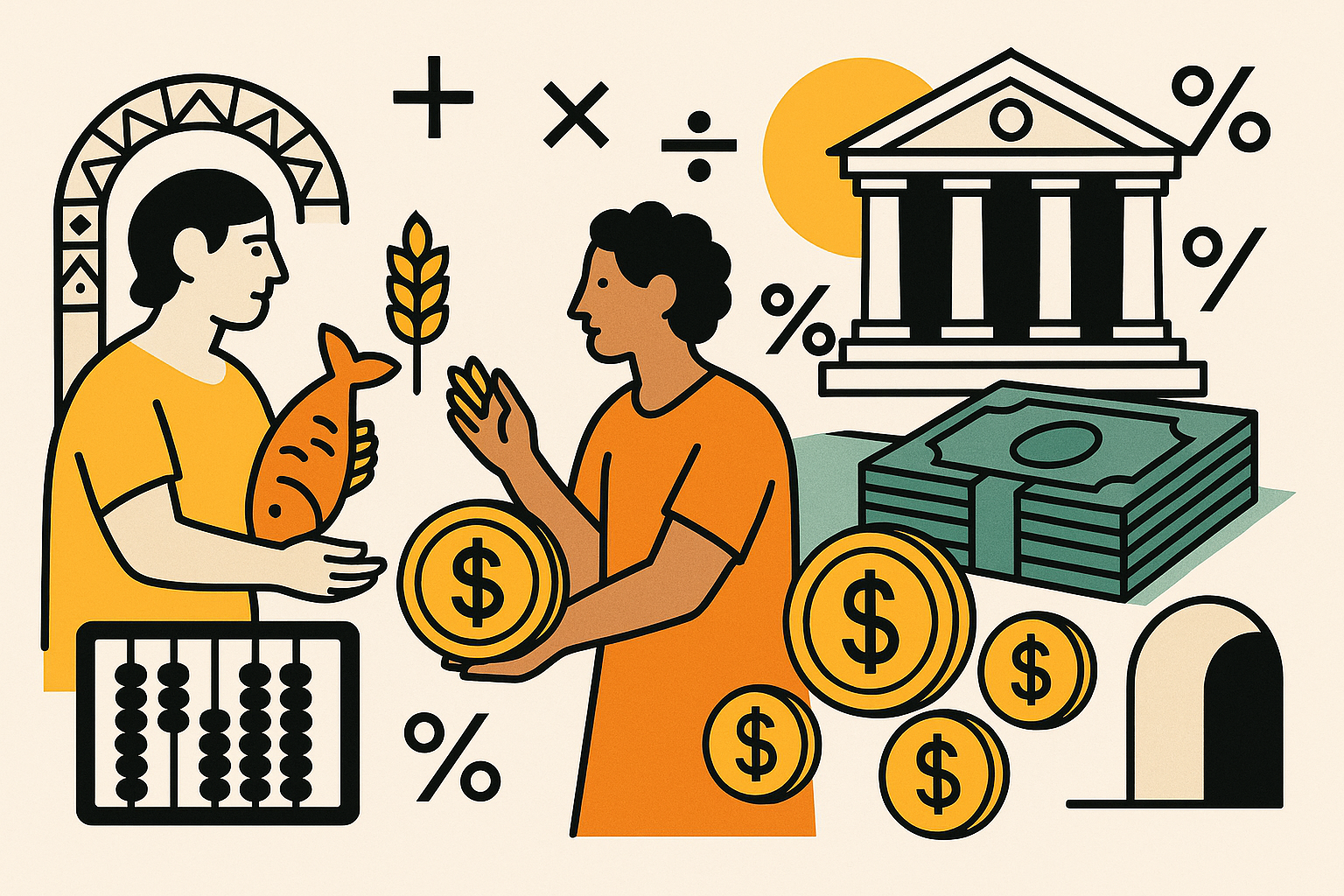
In the earliest days of human civilization, there was no formal money. People exchanged goods through a system called barter. For example, a farmer might swap wheat for a shoemaker's sandals. While simple, barter was often inconvenient. What if the shoemaker didn’t want wheat? Trading slowed down when people's needs did not align, leading to what economists call the ‘double coincidence of wants.’
To overcome bartering limitations, ancient societies began using objects everyone found valuable. Cowrie shells, salt, and even large stone disks served as ‘commodity money.’ These items had value in themselves or were widely trusted for trade. Eventually, precious metals like gold and silver became popular. They could be divided, measured, and carried easily, making transactions simpler and introducing the earliest forms of mathematical counting and measurement into money.
Governments and rulers soon realized they could standardize payments and taxes if they minted metal coins. The first known coins appeared in ancient Lydia (now part of Turkey) around 600 BCE. Coins came in standard sizes, shapes, and weights, often stamped with symbols to show authenticity. This made trade more efficient and brought mathematics directly into daily life: people needed to add, subtract, and compare values to make fair exchanges.
By the Middle Ages, another innovation appeared: paper money. In China, merchants and officials began using promissory notes, which were lighter than carrying bags of metal coins. These early banknotes represented a promise to pay the holder a set amount of silver or gold. Paper money spread gradually to other parts of the world, with European nations adopting it widely by the 17th century. Here, trust became just as important as mathematics—these notes only worked if everyone agreed they held value.
Over time, societies shifted from money that had value itself (like gold coins) to ‘fiat money’—currency declared valuable by governments, but not backed by a physical commodity. The dollars, euros, and yen in use today are all fiat money. Their worth comes from shared confidence in the issuing authority. Central banks now manage the supply of money, adjusting it in response to economic needs and conditions. The mathematics of accounting, economics, and finance play a crucial role in determining how much money is in circulation and how it influences things like inflation and interest rates.
Mathematical concepts are deeply woven into the history and management of money. For example, the ‘time value of money’ explains why having $100 today is more valuable than getting $100 a year from now, due to investment and inflation. Everyday skills like budgeting, calculating interest, and comparing prices all connect back to these foundational principles. In schools, learning about money helps students apply mathematical operations—addition, subtraction, percentages, and beyond—to real-world situations.
Today, while cash is still used, most transactions happen electronically. Credit cards, online banking, and mobile payments require trust in digital records and systems, highlighting both the evolution of money and the growing interplay between technology and mathematics. Cryptocurrencies, like Bitcoin, represent the latest stage, using advanced math and computer science to create money independent of any government.
Money continues to evolve, but its core functions — facilitating exchange, measuring value, and storing wealth — remain the same. By studying how money developed, and by understanding the mathematical ideas behind it, we gain insights that are essential for navigating our personal finances and participating fully in modern society.