How AI is Transforming Mathematics Education and Money Skills
Artificial intelligence isn't just a buzzword—it's rapidly reshaping the way students learn mathematics, connect classroom concepts to real-world money skills, and personalize their educational journeys. Discover the practical impact of AI in mathematics, from homework help to financial literacy, and how these innovations equip learners for today's world.
Artificial intelligence (AI) has become a powerful force in modern education, and mathematics is one subject where its impact is especially noticeable. Across the United States and beyond, teachers and students are discovering how AI-driven tools can help make math learning more personalized, practical, and connected to everyday life, including money management and decision-making.
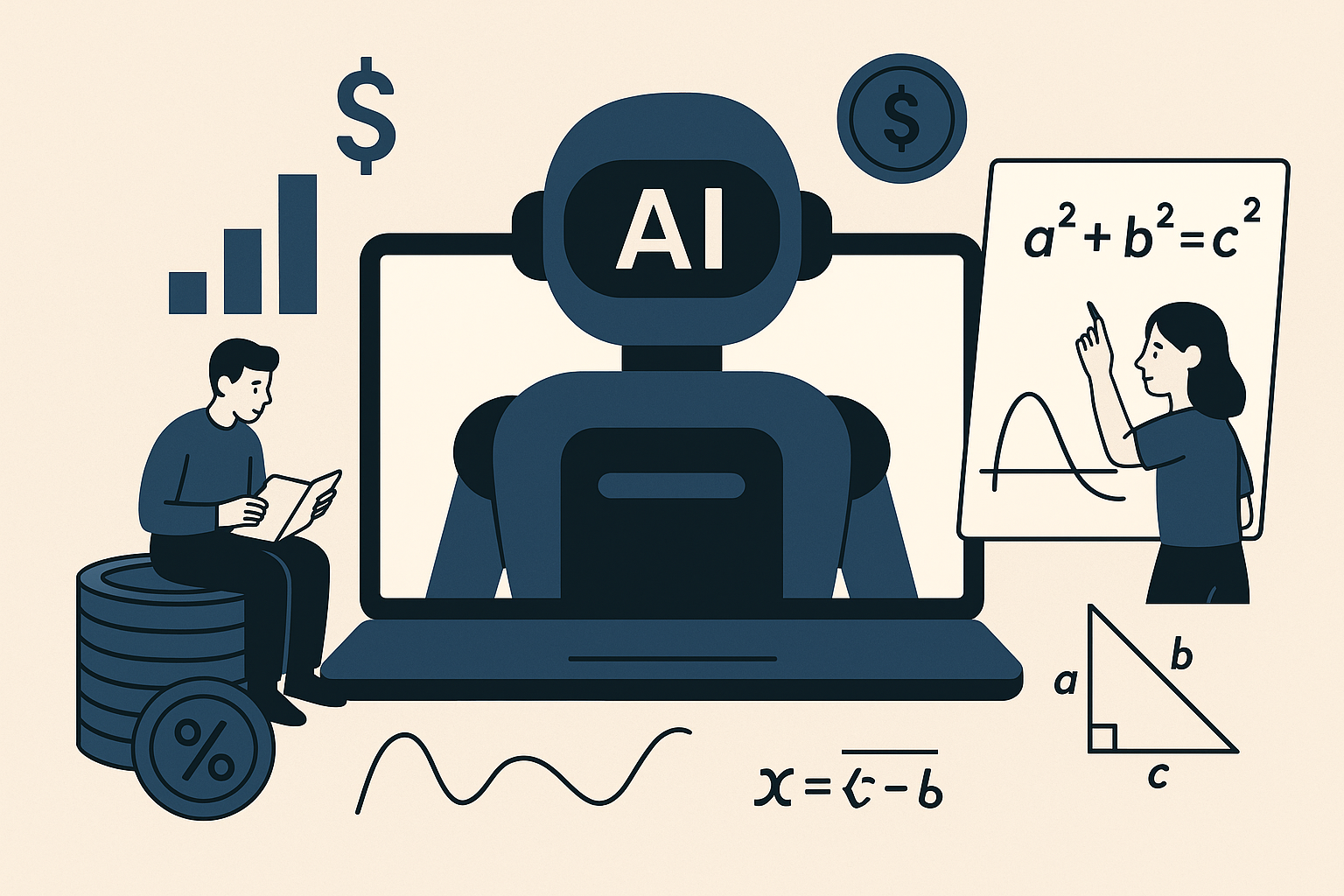
What does AI in mathematics mean? At its core, artificial intelligence refers to computer systems that can perform tasks that normally require human intelligence, such as recognizing patterns, solving complex problems, and learning from data. In mathematics education, AI typically appears in the form of digital tutors, adaptive practice platforms, and smart content generators. These systems analyze a student’s responses and adjust the difficulty, explanation style, or sequence of problems to match each unique learner’s needs.
Take, for example, adaptive learning platforms such as Khan Academy and Squirrel AI. These tools assess a student’s mastery level in real time and adapt lessons accordingly. Struggling with fractions? The software can provide step-by-step hints, additional explanations, or extra practice. Flying through algebra? The platform can skip ahead to more advanced topics, ensuring learners are always challenged but not overwhelmed.
This kind of personalized learning is especially valuable in a country where mathematics education varies widely from state to state. According to information from Wikipedia, the U.S. does not have a single national curriculum for math. Instead, different states—and even school districts—choose their own textbooks, pacing, and standards. AI helps bridge these gaps by meeting students where they are, offering individualized instruction that’s often not possible in traditional classrooms.
One of the most exciting practical connections between AI and mathematics lies in financial literacy. Many students wonder, 'When will I use math in real life?' AI-powered learning tools are increasingly providing answers through real-world money math problems. For example, students can practice calculating discounts during shopping, comparing savings accounts with different interest rates, or budgeting for monthly expenses. By simulating authentic financial decisions, AI platforms show students how mathematical skills help them make smarter money choices now and in the future.
This connection isn’t just theoretical. Financial technology companies, like those co-founded by mathematicians such as Vlad Tenev, use advanced mathematics and AI to power apps that allow users to trade stocks, monitor investments, and manage personal finances. By understanding mathematical concepts—like percentages, compound interest, and probability—students are better prepared to navigate these platforms and make informed financial decisions.
AI also supports teachers in the classroom by providing detailed reports on student progress, helping educators identify which students may need extra help or which concepts the whole class finds challenging. This data-driven insight allows for more effective lesson planning and targeted interventions.
Additionally, mathematics research itself is influenced by AI. Institutions like the London Institute for Mathematical Sciences benefit from AI’s ability to help solve complex problems, analyze huge data sets, and even generate new mathematical conjectures. This not only advances research but also brings cutting-edge ideas into the classroom, inspiring the next generation of mathematicians.
Critics and experts caution that AI should be a tool to assist and not replace human teachers and critical thinking. As AI tools grow more powerful, it becomes increasingly important to balance technology use with the development of deep, conceptual understanding and real-life problem-solving skills.
In summary, AI is transforming mathematics education by personalizing learning, making abstract concepts practical—especially those connected to money—and strengthening both students’ financial literacy and academic confidence. As technology continues to advance, the connection between mathematics, money, and artificial intelligence will only grow stronger, preparing students for an increasingly complex digital world.