How AI Is Transforming Mathematics Education—And Why It Matters for Everyday Life
Artificial intelligence is reshaping how students and professionals learn mathematics, making the subject more interactive and relevant to everyday decisions, including those about money. This article explores the practical uses of AI in math education, real-world connections, and the impact on financial and technology-driven careers.
Artificial intelligence (AI) is rapidly changing nearly every field—and mathematics education is no exception. From elementary classrooms to advanced financial modeling, AI-driven tools are making math learning more accessible, personalized, and practical. But what does this look like in everyday life, particularly when it comes to understanding money and making financial decisions?
First, it helps to understand that mathematics education in the United States is far from uniform, with curricula varying widely between states and even between schools. For years, teachers and parents have sought ways to make learning math more effective and engaging for different learners. Enter artificial intelligence: an emerging partner in the quest to make math education more inclusive and practical.
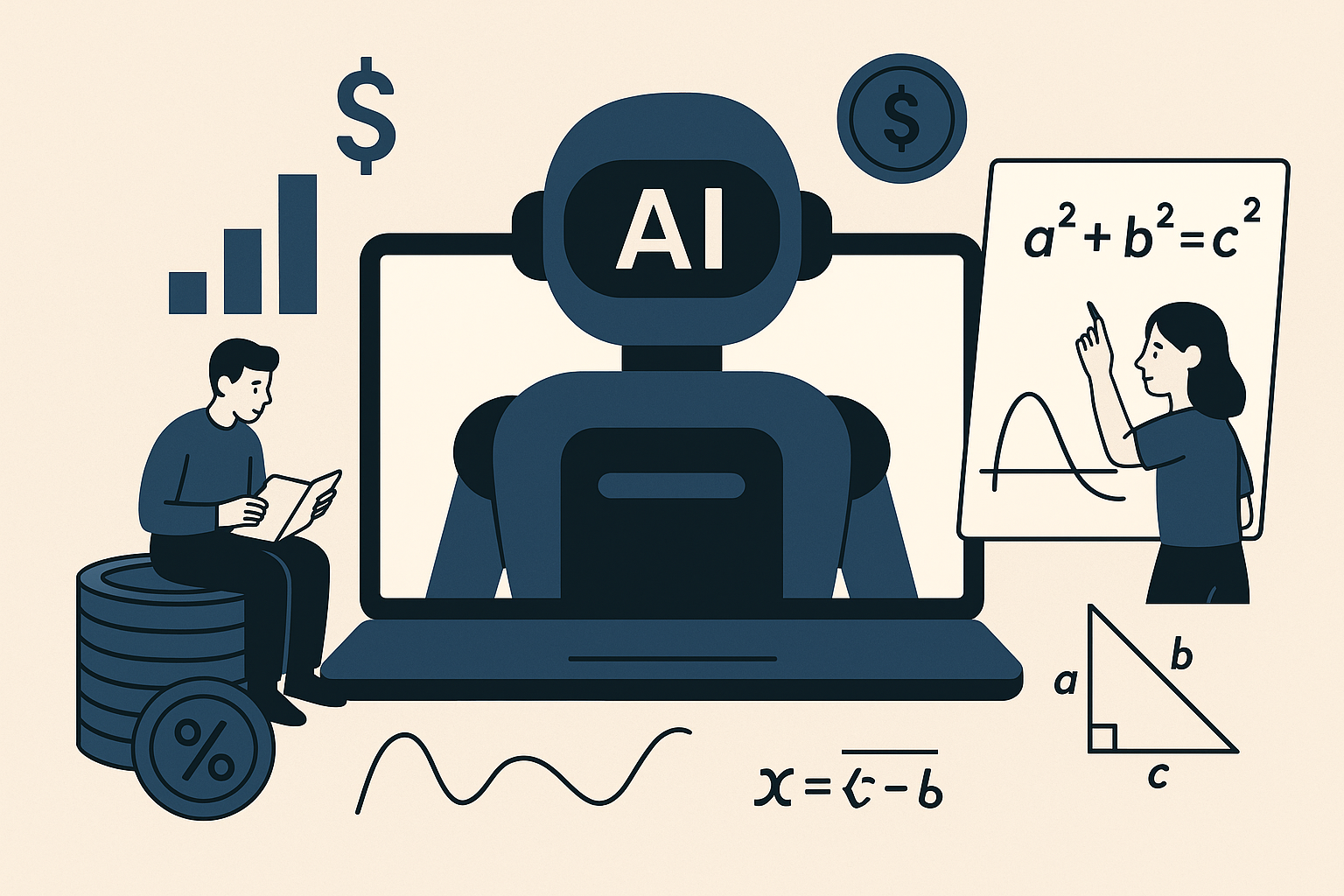
One of the most noticeable changes brought about by AI is the rise of adaptive learning platforms. Programs like those offered by Squirrel AI or Khan Academy use AI to analyze a student's strengths and gaps in knowledge. If a student struggles with fractions, for example, the software can identify the issue and suggest targeted practice problems, explanations, or even short video lessons. This kind of personalized learning ensures that students don’t miss critical concepts, especially those that are essential for making everyday calculations—like splitting a bill at a restaurant, budgeting for groceries, or tracking savings.
But AI’s influence extends beyond the classroom. In the real world, math and money are closely linked. Financial decisions—from managing a bank account to investing in stocks—require mathematical reasoning. Fintech companies and investment platforms increasingly use AI to help users make smarter financial choices. For example, apps may analyze spending habits, predict monthly expenses, or project savings growth, helping people understand the mathematics behind their financial future without requiring advanced knowledge.
AI tools can also make abstract mathematics feel more concrete. For instance, interactive simulations can show how compound interest builds wealth over time or how small changes in a loan's interest rate affect total payments. These applications don’t just teach students how to solve equations; they demonstrate why these skills matter in buying a car, taking out a student loan, or planning for retirement.
For advanced learners and professionals, AI is revolutionizing high-level mathematics and finance as well. Hedge funds and financial analysts employ AI to process massive amounts of market data, uncovering trends that can result in profitable trades. Notably, mathematicians like Alex Gerko, who has funded numerous math clubs and educational projects, highlight the importance of strong math skills for success in these technology-rich fields. Some AI models, relying on mathematical optimization, power the automatic buying and selling in stock trading platforms—a real-world blend of math, AI, and money management.
Despite these advancements, experts caution that AI should be a complement—not a substitute—for human reasoning and understanding. Education platforms often stress the importance of developing critical thinking, often with teachers guiding students as they interpret AI-powered feedback. As Yann LeCun, a noted AI researcher, points out, human oversight remains crucial in education, even as AI takes on a growing role.
As AI continues to evolve, its power to personalize math learning and make it relevant for real-world problems—especially those involving personal and public finance—will likely expand. Understanding both the possibilities and the limitations of these tools can help students and adults alike to not only do better in math class, but also become more confident in handling their financial futures.