A Journey Through the History of Mathematics: From Ancient Counting to Modern-Day Money Matters
Explore the fascinating history of mathematics, its impact on civilization, and how its principles shape our daily financial decisions. From the earliest methods of counting to mathematical finance in the modern era, this article unveils the enduring practical power of math in the real world.
Mathematics has been called the ‘language of the universe,’ but its origins are deeply rooted in everyday puzzles and needs. From tallying livestock thousands of years ago to managing investments today, mathematics has empowered societies to solve practical problems, organize resources, and create new opportunities. Understanding its historical journey helps us appreciate not just its intellectual beauty but also its profound role in our world—especially when it comes to money and economics.
The earliest humans used basic counting methods, making marks on bones or tying knots in cords, to keep track of possessions or trade. Archaeologists have discovered counting artifacts that date back over 20,000 years, showing that the need to quantify and compare was an early and crucial step in social development. As agriculture and trade grew more complex, so did the need for arithmetic, leading to the invention of number systems and written mathematics in ancient civilizations such as Mesopotamia and Egypt.
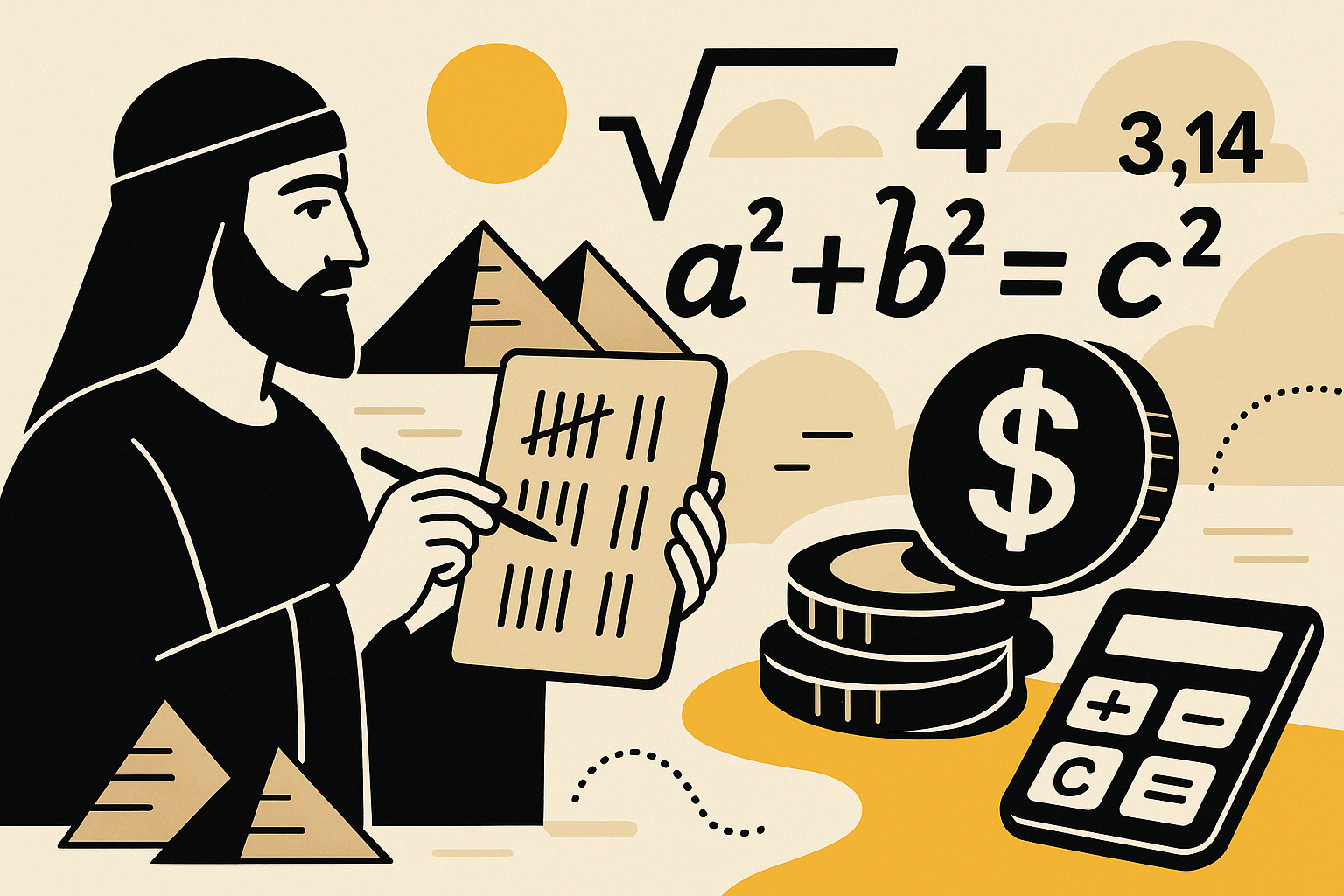
In ancient Egypt, priests and scribes relied on mathematics to build pyramids and measure land for taxation—practical concerns with long-lasting effects. Meanwhile, in India, scholars developed sophisticated ideas about zero and the decimal system, which became essential for computations in both everyday commerce and advanced science. The work of ancient Greek mathematicians such as Euclid and Pythagoras set foundational principles that would later be used throughout the world.
As centuries passed, the study of mathematics spread through the Islamic Golden Age, where scholars preserved and expanded upon Greek and Indian knowledge. Techniques for calculating interest, risk, and profit began to emerge, further connecting math with financial decisions—ideas that remain essential in modern banking and commerce.
By the time of the Renaissance and the development of algebra and calculus, mathematics had become a key driver in fields ranging from navigation to art. Sailors and explorers relied on mathematical techniques to map new lands and keep track of goods, while artists used geometry to create beautiful, proportional works. The era also saw the beginnings of mathematical economics, with thinkers using equations to understand trade, costs, and the value of money.
Today, mathematics is woven into nearly every aspect of daily life, often in ways that are invisible but essential. Buying groceries requires addition and estimation, while saving for a big purchase involves percentages, interest rates, and budgeting. The rise of mathematical finance, or quantitative finance, has made advanced mathematics crucial to modeling markets, pricing loans or mortgages, and optimizing investment portfolios. These techniques rely on centuries-old principles but use modern technology and theory to crunch massive amounts of data.
Mathematics education, whether in elementary school or university, reflects this long history and continued relevance. In classrooms around the world, students learn not just how to calculate but also why these skills are important. Understanding fractions, decimals, and percentages is directly linked to managing money wisely—skills that everyone uses when interpreting a sales discount, comparing prices, or calculating a tip.
In recent decades, there has been growing interest in making math education even more practical and socially relevant. Approaches such as critical mathematics pedagogy encourage learners to connect math to real-life challenges, from budgeting at home to understanding economic inequalities or making environmentally conscious decisions. By grounding mathematical concepts in real-world contexts, students develop both confidence and the ability to make informed choices as citizens and consumers.
The history of mathematics is a story of curiosity, problem-solving, and practical innovation. From ancient counting tools to the digital algorithms that drive our economies today, mathematics remains a bridge between abstract theory and the challenges of everyday life. Whether you’re balancing your checkbook, navigating the stock market, or planning a dream vacation, you’re building on a legacy that stretches back thousands of years—a testament to the enduring power of mathematical thinking.